
Continuous Migration in Practice

Key takeaways
- The legacy system remains operational until the replacement has been validated under real conditions.
- Instead of replacing the system and discovering defects after cutover, continuous migration validates behavior before control is transferred.
- Synthetic testing cannot reproduce the full variability of live environments.
- Reducing coexistence lowers short-term cost at the expense of higher, less recoverable risk.
- Migration decisions should be made at the component level, not the system level.
Questions answered in this article
Migration is not a delivery event. It is a controlled transition of system authority. Continuous migration keeps legacy and modern systems operational concurrently until equivalence is proven under real conditions. This increases short-term cost, but materially reduces systemic risk.
What continuous migration means
Continuous migration is a set of related patterns that enable controlled system transition through coexistence and incremental validation. The legacy system is not decommissioned until the new system has been proven to behave correctly under real operational conditions.
The distinction from traditional migration approaches is fundamental. Instead of replacing the system and discovering defects after cutover, continuous migration validates behavior before control is transferred.
Core mechanisms
These are not optional enhancements. They enable coexistence, validation, and controlled transition.
API façade / routing layer
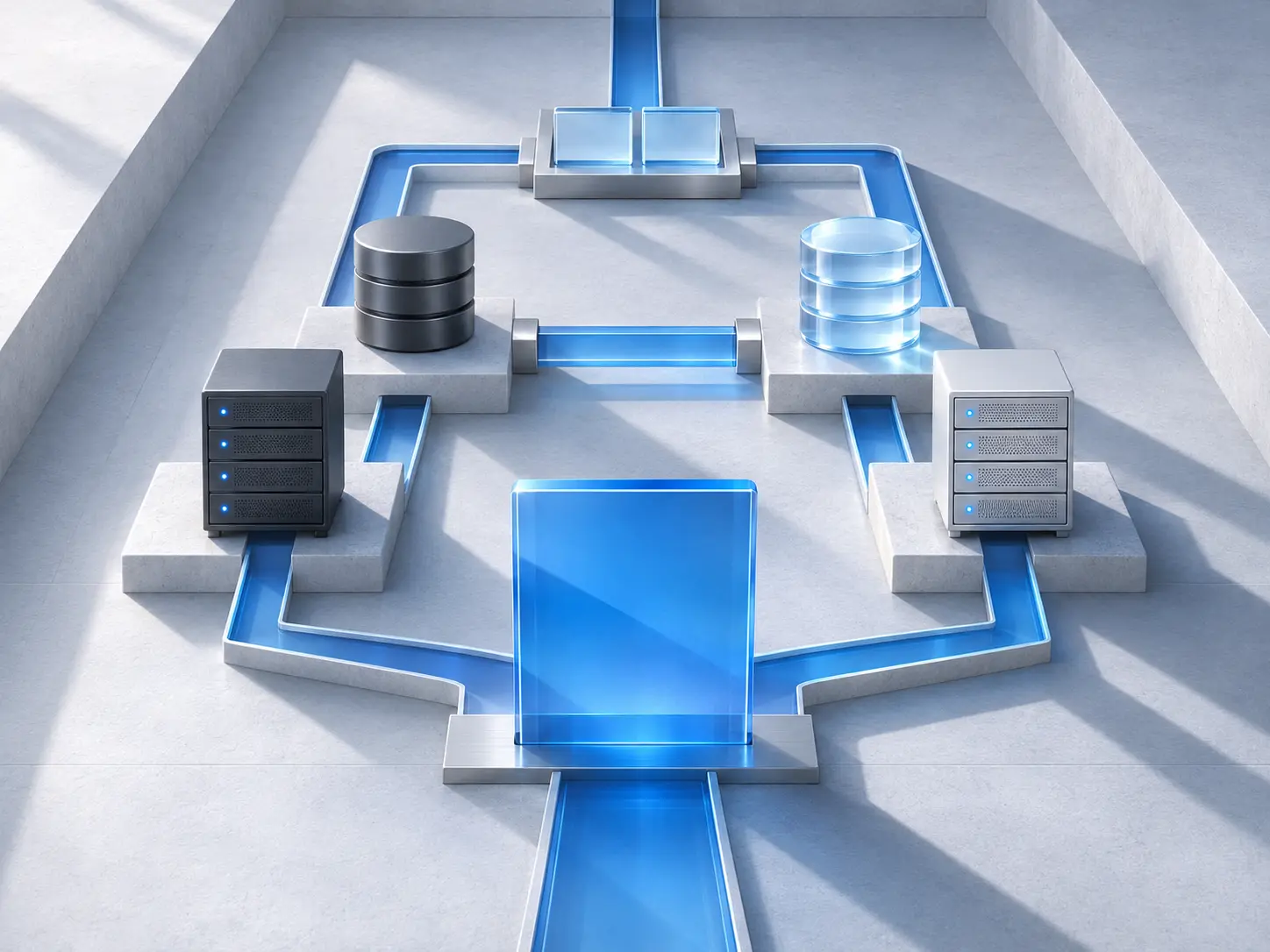
The API façade establishes a boundary between system consumers and internal implementation. All incoming requests pass through this layer, allowing traffic to be routed to either the legacy or new system without changes on the caller side. The façade also provides direct control over traffic, allowing it to be shifted or reverted based on system behavior.
Change data capture (CDC) / dual writes
CDC and dual-write patterns decouple application migration from database cutover. This maintains data parity across environments. The new system operates on current data without requiring a full migration event, and rollback remains possible without data loss.
Shadow testing / replay traffic
Shadow testing replicates real production traffic and sends it to the new system without affecting live outputs. Comparator mechanisms analyze outputs to detect behavioral differences under real conditions before the new system becomes authoritative.
This is the only validation model that reflects actual production behavior.
Controlled routing, synchronized data, and output comparison keep legacy and modern systems operating together while the replacement is validated under real conditions.
Case studies
Dual-run at banking scale
One bank's program implemented dual-run at full banking scale. Incoming traffic to the legacy system was duplicated and processed simultaneously by both the mainframe and the new cloud-native platform. Outputs were compared at the transaction level using real-time comparator mechanisms.
Cutover was driven by validation, not schedule. Only once the new system consistently matched legacy behavior under production load was traffic progressively shifted and the legacy system decommissioned.
Strangler pattern execution
A global platform executed a large-scale migration using the strangler fig pattern. A routing layer controlled traffic flow between legacy components and newly developed microservices. Rollback was preserved throughout. Traffic could be redirected to legacy components if anomalies were detected, limiting exposure.
Data platform dual-run
One bank executed batch processes in parallel across legacy and cloud environments. Outputs from both systems were compared to validate correctness before the new platform became authoritative. The case demonstrates that in data-intensive systems, validation at scale depends on synchronization before replacement.
Orchestration and coexistence
A public-sector tax administration implemented a coexistence model centred on an orchestration layer coordinating interactions between legacy systems and new components. A monitoring-first approach established observability and validation before migration began. Legacy components were decommissioned in stages rather than replaced at once, reducing exposure and allowing issues to be isolated.
Cost of coexistence
The primary objection to continuous migration is cost. Coexistence requires running two systems in parallel, increasing operational overhead and extending timelines. This includes dual infrastructure, reconciliation efforts to compare outputs at scale, expanded monitoring, and the complexity of supporting parallel systems and data paths.
The trade-off is structural. Continuous migration shifts cost forward to reduce systemic risk. Without coexistence, validation is deferred until after cutover, where failures are harder to contain and significantly more expensive.
Coexistence is not inefficiency. It is a control mechanism. Reducing it lowers short-term cost at the expense of higher, less recoverable risk.
When to use which approach
Migration strategy should be determined by system conditions, not tooling preference or target architecture.
Large systems are rarely uniform. Most Delphi environments contain a critical core surrounded by lower-risk components. Migration decisions should therefore be made at the component level, not the system level.
Practical rule: The higher the business criticality and the lower the system understanding, the longer the required coexistence period. Coexistence duration should not be minimized. It is a risk control variable that must be actively managed based on system conditions.
Final verdict
Four decisions determine whether a migration succeeds before a single line of code is moved.
- Define the right success metric. Cutover is not completion. Any program measured at go-live is measuring the wrong moment.
- Sequence understanding before conversion. Discovery is not a delay. It is the work.
- Budget for coexistence explicitly. Dual infrastructure, reconciliation overhead, and extended timelines are not inefficiencies. They are the mechanisms that make safe transition possible. Excluding them does not reduce cost. It defers risk.
- Treat organizational constraints as technical ones. If governance cannot sustain coexistence, or leadership cannot tolerate incremental delivery, the primary risk is not architecture. It is execution.
Migration does not fail because the problem is unsolvable. It fails because organizations choose speed over control – and repeat outcomes that are already well understood.
Related insights




Aleja Armii Ludowej 26
00-609 Warszawa
NIP: 5213218694
KRS: 0000139981
REGON: 015271517

© year 7bulls Sp. z o.o. All rights reserved.
Privacy Policy